
Introduction
Every month, you save some money.
You might keep it in your savings account or put it into an FD.
It feels safe. It feels responsible.
But after a few years, you realise:
👉 Your money is safe… but it’s not really growing.
And then you hear about mutual funds, SIP, and compounding.
It sounds interesting… but also confusing.
So the real question is:
👉 Are mutual funds actually better than FD, or just risky alternatives?
What Makes Mutual Funds Different?
A mutual fund means:
👉 Your money is invested in markets through professionals.
Instead of sitting idle:
- Your money goes into businesses
- It grows with the economy
- It benefits from long-term growth
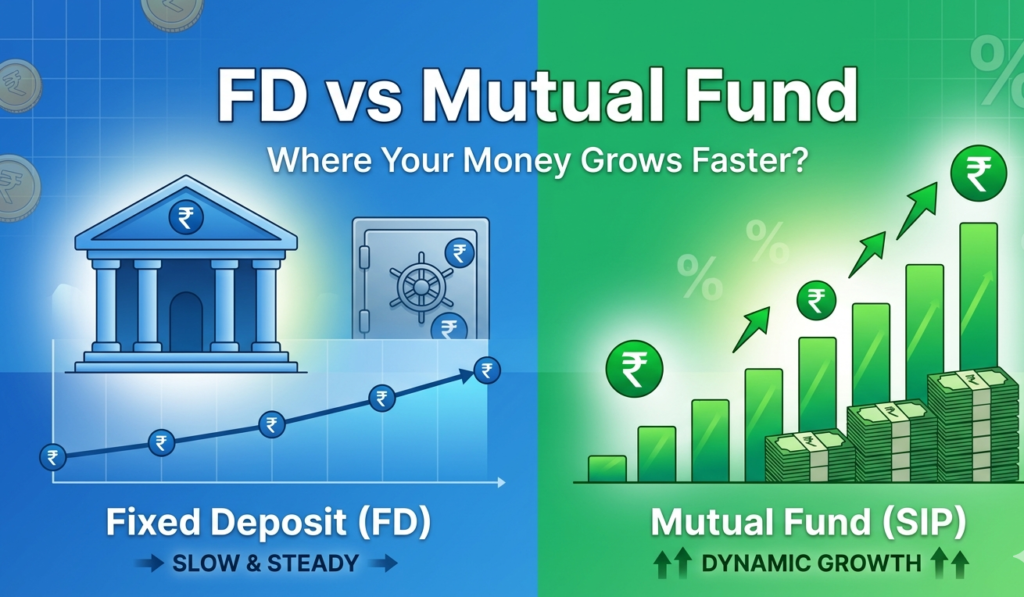
FD:
👉 Fixed return, predictable
Mutual Fund:
👉 Market-linked, growth potential
FD vs Mutual Fund (Simple Comparison)
Let’s understand with a real example:
Scenario:
₹5,000 invested every month for 10 years
| Investment Type | Return | Total Invested | Final Value |
|---|---|---|---|
| FD | 6% | ₹6,00,000 | ~₹8,20,000 |
| Mutual Fund | 12% | ₹6,00,000 | ~₹11,60,000 |
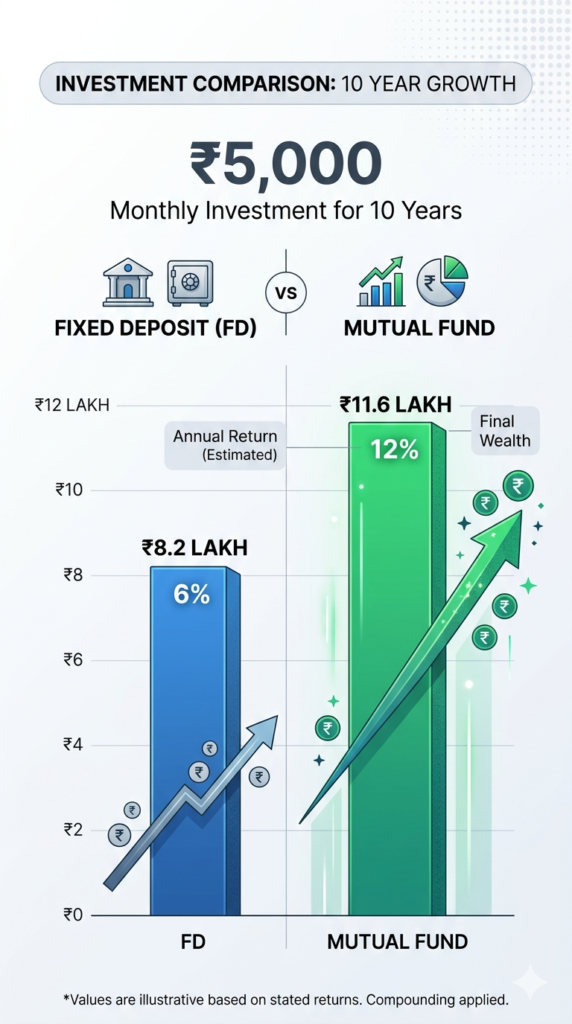
👉 Difference: ₹3,40,000 extra
Same money. Same time.
Only difference = investment choice
The Real Power: Compounding
Mutual funds grow faster because of compounding.
👉 You earn returns on your returns.
Example:
₹5,000 SIP for 20 years:
| Return | Total Invested | Final Value |
|---|---|---|
| 6% (FD) | ₹12,00,000 | ~₹23,00,000 |
| 12% (MF) | ₹12,00,000 | ~₹49,00,000 |
👉 Almost double the wealth
Real Wealth Creation Example
SIP Growth at 12%:
| Monthly SIP | 10 Years | 20 Years | 30 Years |
|---|---|---|---|
| ₹2,000 | ~₹4.6 lakh | ~₹20 lakh | ~₹65 lakh |
| ₹5,000 | ~₹11.5 lakh | ~₹50 lakh | ~₹1.75 crore |
| ₹10,000 | ~₹23 lakh | ~₹1 crore | ~₹3.5 crore |
👉 Consistency matters more than amount
But Are Mutual Funds Risky?
Yes — and this is important.
Risks:
- Market goes up and down
- Short-term losses are possible
- Returns are not guaranteed
Balanced Reality (Important to Understand)
Risk depends on how you invest
If you:
- Invest for long term (5+ years)
- Use SIP instead of lump sum
- Choose diversified funds
👉 Risk becomes manageable
FD Feels Safe… But Is It Really?
If:
- FD return = 6%
- Inflation = 6%
👉 Real growth = ZERO
Your money is not growing
👉 It is just maintaining value
When Should You Choose Mutual Funds?
Mutual funds are better when:
- Want long-term wealth creation
- Investing for future goals
- Stay invested during ups and downs
When FD Still Makes Sense
FD is useful when:
- Need short-term safety
- Want guaranteed returns
- Building emergency fund
Why People Still Avoid Mutual Funds (Psychology)
People don’t avoid mutual funds because they are bad.
They avoid because:
- Fear of losing money
- Lack of knowledge
- Wanting guaranteed returns
- Hearing negative stories
Meanwhile:
👉 Inflation silently reduces savings value
Top 5 Mistakes
- Waiting for “right time”
- Keeping money idle
- Stopping SIP during market fall
- Expecting quick profits
- Investing without understanding
Practical Advice (Very Important)
If you’re starting today:
Step 1:
Start SIP
👉 ₹2,000 – ₹5,000/month
Step 2:
Choose:
- Index fund or flexi-cap fund
Step 3:
Stay invested for:
👉 Minimum 5–10 years
👉 Before starting SIPs, it’s important to structure your income properly and manage EMIs smartly.
Read this guide to understand how salaried employees should plan their investments step by step.
Avoid:
- Panic selling
- Chasing high returns
- Daily tracking
Start This Month
✅ Start SIP (₹2,000 minimum)
✅ Open investment account
✅ Learn basics
✅ Track monthly
✅ Stay consistent
Conclusion
Mutual funds are not risky by default.
They are powerful — if used correctly.
FD gives comfort.
Mutual funds give growth.
The real decision is:
👉 Do you want safety… or long-term wealth?
Read more practical finance blogs on wealthmadesimple.in
Follow @wealthmadesimpleblog for simple money concepts explained clearly