

Introduction
You get your salary. You pay rent. You spend on food, travel, maybe a few online orders… and suddenly, the month ends.
And then comes that thought:
“I’ll start investing next month.”
But next month never really comes.
And slowly, years pass. And the money that could have been working for you… just sat in a savings account earning 3%.
Here’s the truth — if you’re a salaried person, you actually have one of the biggest advantages when it comes to investing.
Why Salaried People Have an Advantage
You might feel your income is limited. But a fixed salary is actually powerful.
Because:
- Your income is predictable
- You can plan in advance
- You can automate investments
- You don’t depend on uncertain earnings
Think of it like this:
If ₹5,000 goes into investments automatically on salary day, you don’t even feel it leaving your account.
That’s how wealth quietly builds.
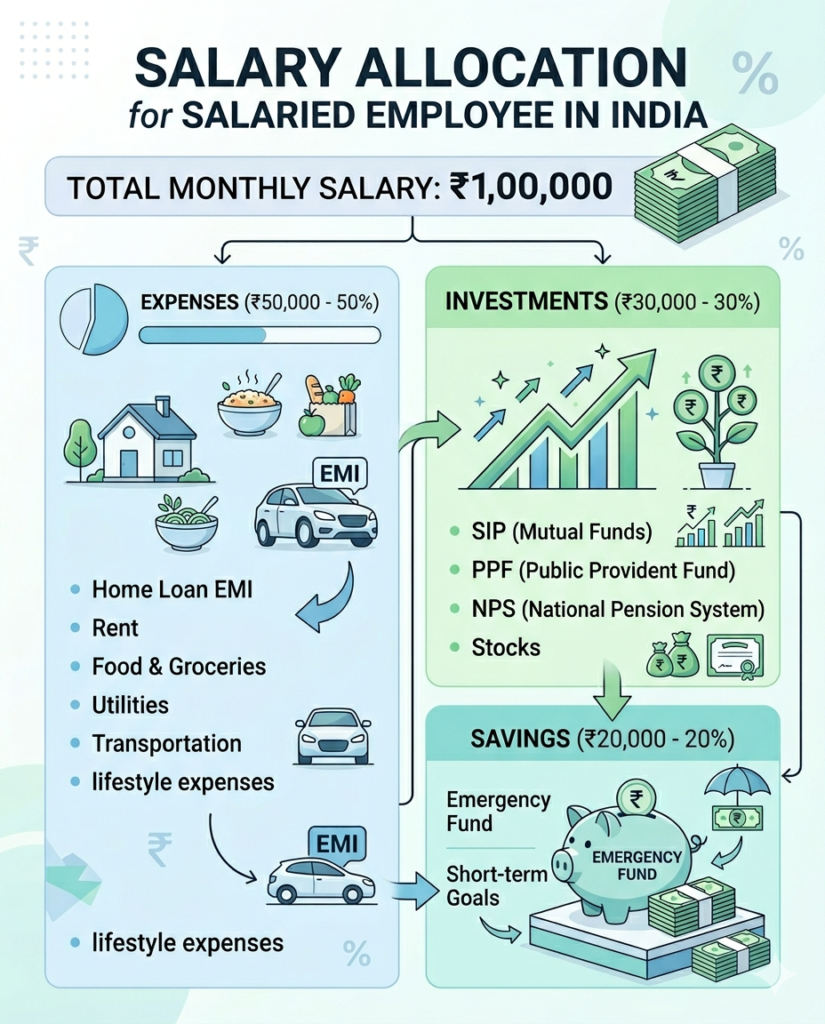
How to Split Your Salary (Including EMIs)
Let’s keep it simple and practical:
- 40–50% → Expenses (including EMIs)
- 20–30% → Investments
- 10–20% → Savings (Emergency Fund)
👉 If you have EMIs (credit card, personal loan, bike, car), they are part of your expenses, not investments.
Salary Allocation Examples (₹25K, ₹50K, ₹1L)
💰 Monthly Allocation Breakdown
| Category | ₹25,000 Salary | ₹50,000 Salary | ₹1,00,000 Salary |
|---|---|---|---|
| Expenses (incl. EMIs) | ₹15,000 | ₹25,000 | ₹50,000 |
| • EMI (if any) | ₹0–₹2,000 | ₹5,000 (bike/personal/credit) | ₹15,000 (car/home/credit) |
| Emergency Fund | ₹2,500 | ₹5,000 | ₹10,000 |
| PPF | ₹1,000 | ₹2,500 | ₹5,000 |
| Mutual Fund SIP | ₹3,000 | ₹10,000 | ₹20,000 |
| NPS | ₹1,000 | ₹3,000 | ₹5,000 |
| FD / Liquid Fund | ₹2,500 | ₹4,500 | ₹10,000 |
Think of Salary After EMI (Simple Trick)
👉 Your salary is not your real salary.
If you earn ₹1,00,000/month
And your car EMI is ₹20,000
👉 Your real usable salary = ₹80,000
Now plan everything based on ₹80,000.
📊 Practical Breakdown
- Expenses → ₹40,000
- Investments → ₹20,000
- Savings → ₹10,000
- Buffer → ₹10,000
👉 Salary – EMI = Your real planning number
Where Do EMIs Fit in Your Plan?
You might feel:
👉 “I’m already paying EMI… I can’t invest.”
But:
- EMI = past decision
- Investment = future security
Both must run together.
Rule:
- Keep EMIs below 30–35% of salary
- Never stop investing completely
What Each Investment Means (Simple Explanation)
- Emergency Fund → Money for unexpected situations
- PPF → Safe long-term government savings
- Mutual Fund SIP → Monthly investment in markets
- NPS → Retirement + tax saving (explained in our Union Budget article)
- FD / Liquid Fund → Low-risk short-term money
👉 If you’re new and confused about markets,
Click here to understand stock market basics before investing
Real Wealth Creation Example
Let’s assume 12% average return:
📊 SIP Growth
₹2,000/month:
- 10 years → ~₹4.6 lakh
- 20 years → ~₹20 lakh
- 30 years → ~₹65 lakh
₹5,000/month:
- 10 years → ~₹11.5 lakh
- 20 years → ~₹50 lakh
- 30 years → ~₹1.75 crore
₹10,000/month:
- 10 years → ~₹23 lakh
- 20 years → ~₹1 crore
- 30 years → ~₹3.5 crore
👉 Consistency > amount
Comparison: All Salary Levels
| Salary | SIP | EMI | 30-Year Wealth |
|---|---|---|---|
| ₹25,000 | ₹3,000 | ₹0–₹2,000 | ~₹1 crore |
| ₹50,000 | ₹10,000 | ₹5,000 | ~₹3.5 crore |
| ₹1,00,000 | ₹20,000 | ₹15,000 | ~₹7 crore |
Why People Still Don’t Invest
- “I don’t earn enough”
- “I already have EMIs”
- “I’ll start later”
This is lifestyle inflation.
Income increases → expenses increase → investing gets delayed.
Top 5 Mistakes
- Waiting for higher salary
- Keeping money idle
- No emergency fund
- Unnecessary EMIs
- Stopping SIPs during market fall
Practical Advice (Very Important)
- Start small (₹1,000–₹2,000 is enough)
- Automate SIP
- Build emergency fund
👉 If saving itself feels difficult right now, click here to read how to save money every month before you start investing
- Keep EMIs under control
- Plan using your real salary (after EMI)
- Stay consistent
✅ Start This Month
- Start SIP (₹2,000)
- Open emergency fund account
- Start PPF
- Track expenses
- Fix investment date
Conclusion
You don’t need a big salary.
You need:
- A plan
- Discipline
- Consistency
Because wealth is built not by earning more…
But by managing what you already earn — even after EMIs.
Read more practical finance blogs on wealthmadesimple.in
Follow us on Instagram @wealthmadesimpleblog for simple money concepts explained clearly
Pingback: Mutual Funds vs FD: Which Grows Your Money Faster in India?