
Introduction
You swipe your credit card, and nothing happens instantly.
There’s no immediate deduction. No message saying money is gone. And that’s exactly why it feels so easy to use. A small swipe here, a quick online order there — it doesn’t feel like spending.
But then the bill arrives.
₹8,000… ₹15,000… sometimes even more than expected.
And suddenly you start thinking, “Did I actually spend this much?”
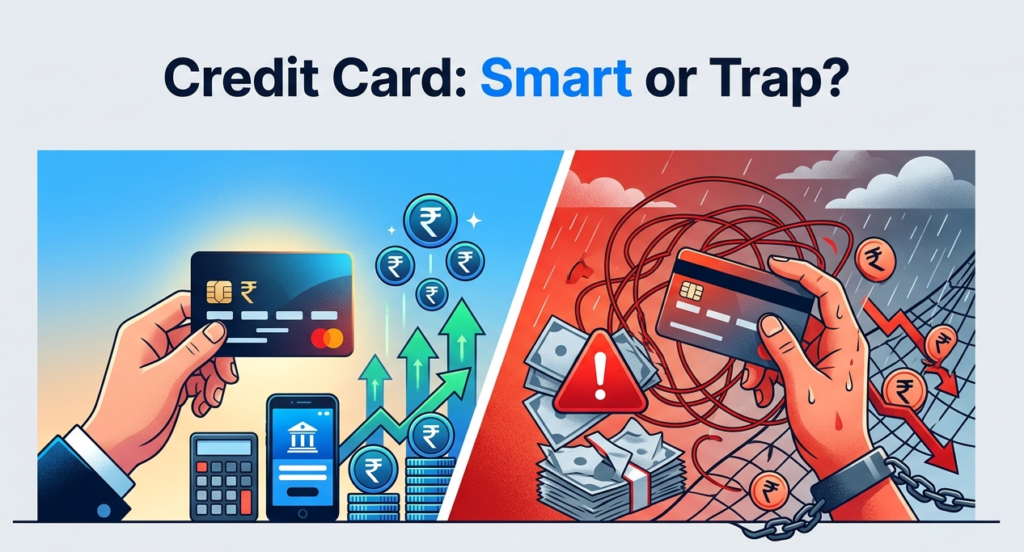
Credit cards are powerful tools. They can make your life easier, give rewards, and even help you build a financial profile. But without understanding how they work, they can quietly turn into a problem.
Why Credit Cards Were Created
Credit cards were not created to trap people. In fact, their original purpose was quite simple — to make payments easier and give people short-term access to money when needed.
Banks like HDFC, ICICI, SBI, Axis Bank, and American Express introduced credit cards to promote cashless transactions and provide convenience. Instead of carrying cash or waiting for bank approvals, people could spend first and pay later within a fixed time.
Over time, this system evolved into something much bigger — combining payments, rewards, credit history, and lifestyle benefits into one product.
Why People Use Credit Cards Today (Practical Reasons)
Today, credit cards are used not just for convenience, but for multiple practical benefits. Most people start using them for ease — swiping instead of carrying cash or typing UPI every time.
But gradually, they discover additional benefits. Cashback and reward points make spending slightly more rewarding. Discounts during sales, especially on platforms like Amazon and Flipkart, can save thousands of rupees.
Premium cards from banks like HDFC Regalia, ICICI Sapphiro, and SBI Elite even offer airport lounge access, which makes travel more comfortable without extra cost.
Some people also use credit cards to convert big expenses into EMIs, allowing them to manage cash flow better. And if used correctly, regular payments also help in building a good credit score, which becomes useful when applying for loans later.
How Credit Card Billing Actually Works (Very Important)
This is where most confusion happens.
Many people use credit cards daily but don’t fully understand how the billing system works. And this lack of understanding is where mistakes begin.
Let’s break it down with a simple example.
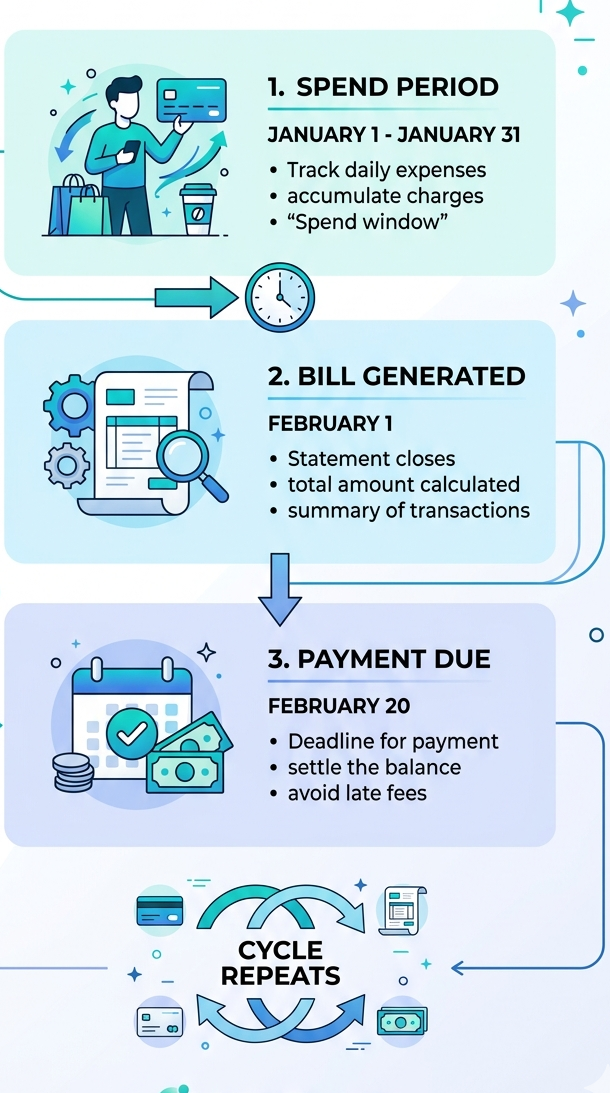
Billing Cycle Example
Assume your credit card has:
- Billing Date: 1st of every month
- Due Date: 20th of every month
Now let’s see what happens.
If you spend money anytime between 2nd January and 31st January, all those transactions are grouped together and your bill is generated on 1st February.
So if your total spending is ₹10,000 during January, your bill of ₹10,000 will be generated on February 1, and you’ll have time until February 20 to pay it.
If you pay the full amount before the due date, you don’t pay any interest. But if you don’t, interest starts getting added — and this is where things can go wrong.
The Golden Trick Most People Don’t KnowThere’s one simple trick that can help you use credit cards more efficiently.
If you spend just after your billing date, you get the maximum time to repay.
For example, if your billing date is February 1 and you spend on February 2, that transaction will be billed on March 1 and due around March 20. That gives you almost 45–50 days to pay.
Used smartly, this can help you manage cash flow without stress.
Minimum Payment Trap (The Most Dangerous Part)
This is where many people fall into trouble without even realising it.
Let’s say your total bill is ₹10,000, and the minimum amount due is ₹500. Paying ₹500 might feel like a relief, but the remaining ₹9,500 doesn’t disappear.
Instead, interest starts getting charged on that amount — often around 3% per month, which is about 36% per year.
Over time, this small unpaid amount grows into a larger burden. What felt manageable initially slowly turns into a cycle of debt.
Real-Life Example
Imagine you earn ₹40,000 per month and spend ₹15,000 on your credit card. If you start paying only the minimum due, the remaining balance keeps rolling over.
Next month, you add new expenses, and interest gets added on the old balance. Within a few months, your total outstanding can easily reach ₹30,000–₹50,000.
And the worst part is — it doesn’t feel sudden. It builds slowly.
When Credit Cards Are Actually Useful
Credit cards can be extremely useful if they are handled with discipline. When you treat your credit card like your own money — not borrowed money — it works in your favour.
If you only spend on planned expenses like groceries, fuel, or bills, and ensure that you pay the full bill every month, you get the benefits without any cost. Cashback, reward points, and discounts become an added advantage rather than a reason to spend more.
The idea is simple — use the card for convenience, not for increasing your lifestyle beyond what you can afford.
When Credit Cards Become a Problem
The same credit card becomes dangerous when it starts replacing your financial discipline. When spending becomes impulsive, or when you begin to rely on it for lifestyle expenses, it slowly shifts from being a tool to being a dependency.
Carrying forward unpaid balances adds high interest, and since it compounds monthly, it grows faster than most people expect. Over time, this leads to stress, financial pressure, and loss of control.
The card doesn’t change — the usage does.
Practical Advice (Very Important)
If you want to use a credit card smartly, the approach needs to be simple and controlled.
Start by using the card only for fixed and necessary expenses like fuel, bills, and groceries. These are expenses you would incur anyway, so using a credit card here gives you benefits without increasing spending.
Make it a strict rule to always pay the full bill before the due date. This ensures you never pay interest, which is the biggest advantage of using a credit card.
Also, keep your usage within 30% of your credit limit. This helps in maintaining a healthy credit score and prevents overspending.
👉 Before using a credit card actively, it’s important to control your monthly spending.
Read this guide to understand how to manage your expenses better and avoid unnecessary spending.
👉 If you already have EMIs, your planning becomes even more important.
Learn how to manage EMIs along with investments without disturbing your financial stability.
Avoid falling into habits like paying only the minimum due, making impulsive purchases, or using multiple credit cards unnecessarily. These small behaviors are what usually lead to bigger problems later.
Start This Month
- Use your credit card only for essential expenses
- Track every transaction
- Set reminders for payment dates
- Always pay the full amount
- Avoid unnecessary EMIs
Conclusion
Credit cards are not good or bad on their own.
They are simply tools.
Used with discipline, they give you convenience, rewards, and financial flexibility. Used carelessly, they can quietly lead to debt.
The real question is not about the card.
👉 It’s about how you use it.
Read more practical finance blogs on wealthmadesimple.in
Follow @wealthmadesimpleblog for simple money concepts explained clearly